


- Info
- Data
- Colors
- Photos
- Downloads
General
The challenge we faced in developing the new DHV 1-2 glider was to create a glider with better performance than the Mistral 2 despite the more stringent DHV regulations. Numerous new designs with differences in the basic form and profile variations underwent computer simulation before the decision on the first prototype of the MISTRAL 3 was made. The best product from this series of tests was worked on over a long period of time before being ready for production and was released as the MISTRAL 3.
The MISTRAL 3 combines new safety requirements in the DHV 1-2 category with outstanding climb and glide performance along with lively handling.
The dynamic design of the MISTRAL 3 emphasises this requirement.
Target market
With its agile handling and performance-oriented design, the MISTRAL 3 is aimed at advanced pilots and pilots taking a step back from higher categories.
Anyone looking for a glider for cross-country flying with good passive safety will find the MISTRAL 3 the ideal choice.
Flight behaviour
Despite being performance-oriented, the MISTRAL 3 is very easy to launch.
The sedate flight behaviour of the MISTRAL 3 allows a wide range of pilots to exploit the full performance potential of this glider.
The MISTRAL 3 responds directly to small control inputs which gives the glider very lively handling.
The light brake pressure allows pleasant turns in long thermal flights, but then increases progressively to offer high safety reserves.
Despite high steering agility, the Mistral 3 has good dampening and very high stability in turbulence.
Design
The MISTRAL 3 has 50 cells and an aspect ratio of 5.25.
The sweepback and elliptical form give the MISTRAL 3 a slim, sporty look which gives an indication of its performance potential. The elaborate interior of V-tapes and a system of load-bearing tapes ensure good canopy stability.
The riser system of the MISTRAL 3 was integrated with the canopy to allow effective acceleration with only the slightest drop in performance.
A line configuration suited for the canopy design with reduced overall line use reduces the overall drag and increases the agility and performance of this SWING product.
Workmanship
Consistent development of the computer programmes used allows precise manufacturing guidelines which ensure high profile accuracy and exactly defined tension in the canopy. Use of high-quality materials and strictly controlled manufacturing creates a product of the highest quality. Practical detail solutions such as the ERGO.GRIP – brake handles and DIRT.EX openings to remove dirt from the inside of the glider complete a very positive overall picture of the Mistral 3.
| Mistral 3 | 22 | 24 | 26 | 28 | 30 |
|---|---|---|---|---|---|
LTF homologation |
1-2 | 1-2 | 1-2 | 1-2 | 1-2 |
| 55 - 80 | 65 - 90 | 80 - 105 | 95 - 125 | 105 - 140 | |
Cells |
50 | 50 | 50 | 50 | 50 |
Wing area (m²) |
25,5 | 27 | 29,2 | 31,4 | 32,9 |
Wing area projected (m²) |
22,1 | 23,5 | 25,4 | 27,3 | 28,5 |
Wing span (m) |
11,6 | 11,9 | 12,4 | 12,8 | 13,1 |
Projected wing span (m) |
9,2 | 9,5 | 9,9 | 10,2 | 10,5 |
Aspect ratio |
5,25 | 5,25 | 5,25 | 5,25 | 5,25 |
Projected aspect ratio |
3,8 | 3,8 | 3,8 | 3,8 | 3,8 |
Glider weight (kg) |
6,1 | 6,4 | 6,8 | 7,1 | 7,4 |
Min. sink rate (m/s) |
1,05 | 1,05 | 1,05 | 1,05 | 1,05 |
Max speed (km/h) |
>50 | >50 | >50 | >50 | >50 |
Trim speed (km/h) |
37 | 37 | 37 | 37 | 37 |


<
>
Special designs
In general there are two ways to individualise the paraglider,
- firstly by a special design (see below) and,
- secondly, by adding an advertising message to it.
Paraglider sponsoring
Here are some facts and information which you may find helpful in finding sponsors or applying for sponsorship.
Note
The delivery time for special colors can vary strongly due to capacity utilization of our production. Please contact your dealer to inquire the respective delivery time.


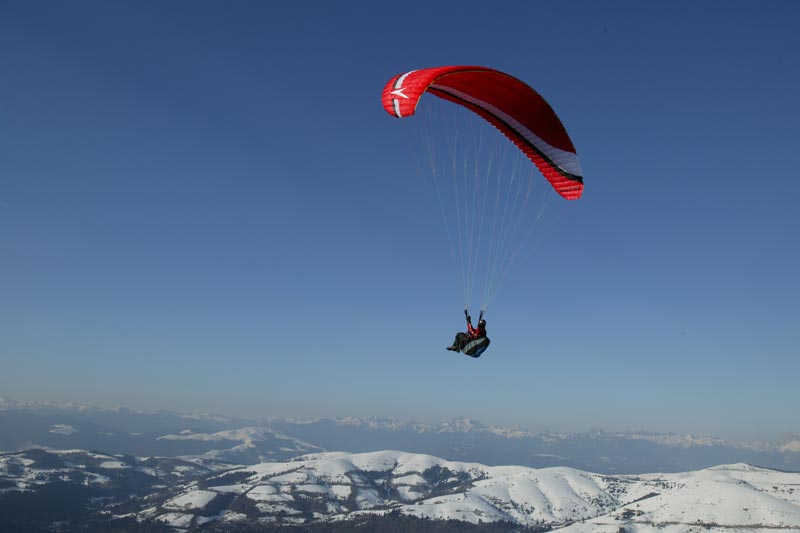
Foto: Martin Scheel / azoom.ch - Location: Bassano del Grapa / Italy