L'APUS RS est une mini voile tout-terrain, c’est l'outil universel pour un plaisir garanti dans pratiquement n'importe quelle occasion.
Il y a deux versions (APUS RS ou APUS RS Hike) et les utilisations possibles sont nombreuses allant de vols en dynamique par forts vents sur votre site local, aux randonnées Hike & Fly. L’APUS RS s’intégrera parfaitement dans vos bagages grâce à sa taille compacte et son poids très modéré.Elle est destinée à tous les pilotes de parapente et aux pilotes de mini voiles, pour qui le désir d'aventure et la passion pour le vol sont une priorité absolue.
L'APUS RS est disponible en version standard et en version light de randonnée. La conception de la version de randonnée (Hike) a été optimisée en fonction du poids. L’APUS RS Hike utilise un tissu de 27g/m² pour l’intrados et l’extrados au lieu de la combinaison de 41g et 34g pour la version standard. Nous utilisons des élévateurs en Dyneema extrêmement légers combinés avec des liaisons souples plutôt que des élévateurs classiques. Le tissu de 27 g/m² n’est disponible qu’en bleu et rouge, de sorte que l’APUS RS Hike est uniquement livrable dans la combinaison de ces deux couleurs. Des couleurs spéciales ne peuvent être commandées que pour la version standard.
Comportement en vol
Selon la charge alaire, le comportement en vol de l’aile varie de standard à dynamique (voir le tableau). En même temps, la maniabilité équilibrée et l'agréable amortissement en roulis confèrent une sensation de vol agréable et familière avec des performances exceptionnelles.
Bonus
Le concept RAST innovant s'est également révélé pertinent dans cette catégorie de parapente. Le comportement d’écopage retardé garantit une phase de gonflage facile à contrôler et minimise toute tendance aux décollages involontaires, en particulier dans un terrain très escarpé ou dans des vents forts. Une fois en vol, le RAST stabilise la voilure dans l'air turbulent et assure une résistance à la fermeture au dessus de la moyenne, ce qui a un effet positif sur la performance.
Le rapport de voyage de Serge Shakuto - Projet KilimanjaroFermer!
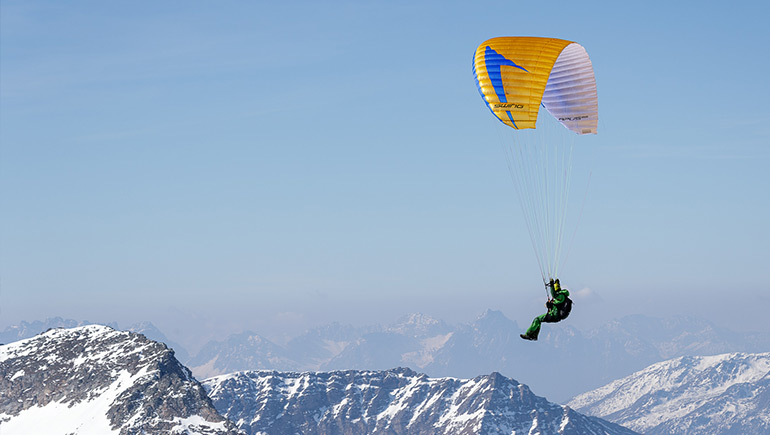
One friend invited me to climb Mount Kilimanjaro on Christmas Eve. I was happy to join him, but as a fan of hike&fly I took my wing with me to fly down. The choice wasn't easy. On one hand it's quite far to fly and wing needs a good glide ratio, on another most probably it will be windy at the summit meaning not an easy take off. So I decided that mini wing will fit perfectly. My choice was a brand new Swing Apus RS 18. It was clear that this wing combines good speed, flight characteristics and safety (20 sq.m, a.r.-5.0, RAST)
It's forbidden to hike Kilimanjaro without guides. For every tourist there should be at least one guide and three porters. In fact there are more. Our team was 12 people including guides, porters and even a chief. At first it looked like too much, but after it helped us to concentrate on the quite tough climb and preparation for the flight.
Twice a day we had compulsory health check, cause on high altitude you can get sudden pulmonary edema or even cerebral edema. Every year around 20 tourists and guides die on the mountain.
For the flight I also needed a permit, which can be given only in return of some charity. I paid for the school of five local kids. Together with permits from local aviation and military it costed around 3000 Euro. The idea of a flight made us change the route of climbing. Initially we supposed to use very long path around the mountain, but we had to change it to the shortest and most dangerous route called Western Breach in order to have couple of days at the summit, waiting for the launch window.
The biggest challenge of the Western Breach is the constant climb from sea level to almost 6000 without acclimatization. And the hardest part there is the final steep one-kilometer-climb to the summit over rockfalls just at the time when mountain sickness starts to show up.
All of it made our expedition really unique and interesting! Kilimanjaro is a very popular tourist destination. In a year around 35 thousand people climb to the summit. At the classic camp locations there is hardly enough space for tents. And knowing all this, we only met other people at the entrance to National park and at the summit.
The day of the summit attempt was Christmas day. A kilometer climb on the steep crumbling slope. It was necessary to leave the camp not later than 5.30 am in order to make the climb before stones will thaw and start falling down. In several years there were few mountain climbers who were killed by the stones. Here at a height slightly over 5000 meters I started feeling first sights of the mountain sickness, but quite tricky terrain helped to not think about headache.
Most of the tourists spend no more than 30 minutes at the summit and then, frozen, hurry to get down and drink hot chocolate. But we had to wait for a good weather for a flight. First two days strong wind was blowing from the wrong direction. We decided to go around the crater to find another launch area somewhere with the side wind.
But wind happened to be too strong even for my mini wing and all the attempts to launch had no success. As a result I spend so much energy that I fall down in a tent and couldn’t leave it till the next morning.
It is a strange feeling when you are in such an interesting place, with desert, volcanic crater, huge glazers, that stay like blue buildings on a sand and in your head there is not even a thought to move. You just lay in your sleeping bag wearing all your clothes, try to get warm and think only about how to get out of there as soon as possible. The sleep is out of the question. Last three nights I was just lying in the tent, listening to an audio book and staring at the ceiling. I was ready to go down, my self-esteem would not be harmed too much as I knew that from many attempts to fly down Kilimanjaro only few lucky ones made it. But sudden phone signal brought good news of the weather forecast for the next morning and it helped me to put all the energy left and try again. Third morning on the summit was really cold, but almost windless. The sun rose from the horizon and started to warm the slopes. I got up, had a cup of hot tea and went to the takeoff zone, where there were some blasts of a side wind. I got ready and finally launched with a happy cheers of our team and some jealous looks from those who just reached the summit and had to climb down. If I would have a tandem at that moment I could easily make a lot of money.
The flight was going smooth, according to the plan. I had to fly away from the slope, turn at 180 degrees and fly with the wind to the south in the direction of Moshi town, enjoying the beauty of the glacier and clouds under my feet. The distance was about 30 kilometers and I made it within half an hour, which usually takes two days of hiking.
It was my first flight on the new Swing Apus RS. Before expedition I didn’t have time to test it. But it turned to be very easy in use, even at the altitude of 6000 meters. Easy start, good speed and great glide ratio.
Another successful project is finished! I got amazing experience of high mountain climbing and also realized that willpower is like a toothpaste. It seems like there is nothing left, but you can always squeeze a little bit more to reach your goal.
Reto Reiser flew with his APUS RS 14 on 19.06.2019 fabulous 153 km through the Swiss Alps! He was able to show the performance of the APUS RS impressively.





 Le rapport de voyage de Serge Shakuto - Projet Kilimanjaro
  Fermer!